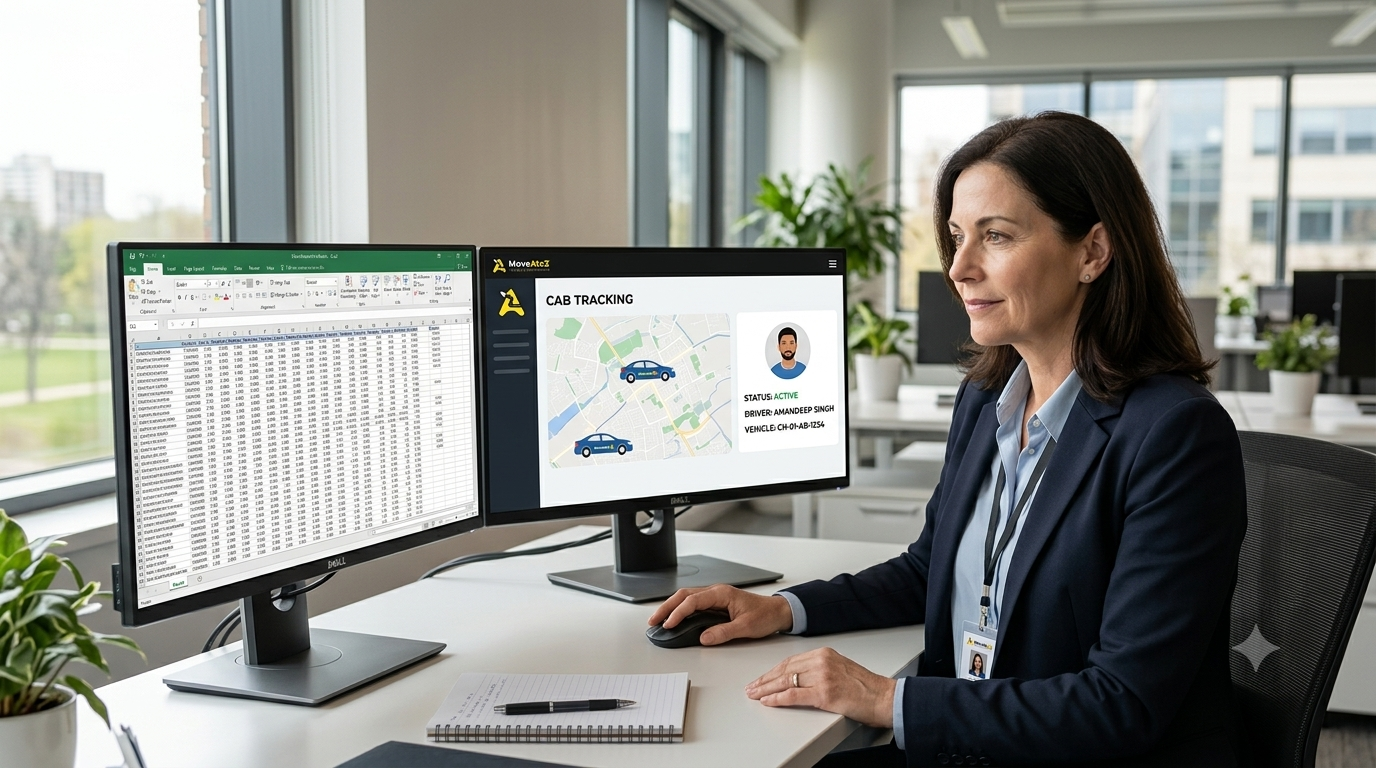
Vendor switches get talked about like a single event — "we moved to a new system" — when in reality it's two different experiences happening at once. One is what the admin actually goes through: the nerves, the double-checking, the small moments of relief. The other is what's happening underneath, in the Staff Transportation Management Software itself, largely invisible unless you go looking for it. Here's both, side by side.
Priya has run transport through the same vendor for two years, mostly through phone calls and a shared spreadsheet nobody fully trusts. The decision to switch to proper Staff Transportation Management Software wasn't hard to justify — the hard part is the week before go-live, when every instinct says "what if this breaks something that currently, barely, works."
Behind the scenes, none of this is dramatic. Employee rosters get imported, shift patterns get mapped, and existing vendor and driver records get set up inside the admin dashboard. Staff Transportation Management Software doesn't need employees to do anything differently yet — the groundwork happens quietly, before a single trip actually runs through the new system.
Priya checks her phone more than usual. The first cabs of the morning are running through the new system, and she's half-expecting a flood of confused messages. What she gets instead is smaller than expected — one employee asking how to find their OTP, another double-checking their pickup time. Nothing close to the chaos she'd braced for.
Under the hood, the shift is mechanical rather than dramatic. Automated rostering assigns drivers based on the shift patterns set up the week before. Each employee's app shows their trip, their driver, and an OTP for boarding verification. Admins can watch the whole thing unfold on a live map, seeing every vehicle in real time instead of waiting for a vendor to confirm status over the phone.
By day three, Priya notices something she wasn't expecting: she's not fielding the usual stream of "where's my cab" messages. Employees are checking the app instead of texting her directly. She still gets the occasional question, but it's a fraction of what it used to be — and the questions that do come in are easier to answer, because she can see exactly what's happening rather than guessing.
This is where Staff Transportation Management Software starts doing the quieter part of its job — collecting real data instead of relying on Priya's memory or a vendor's word. Every trip gets logged. Every driver assignment goes through a document verification step before being confirmed. If an employee triggers an SOS, it routes straight to Priya's dashboard with a live location attached, rather than depending on someone picking up a phone at the right moment.
A month later, Priya pulls her first real report out of the system — trip counts, on-time performance, cost breakdowns by route. It's the first time she's had this kind of visibility without manually reconstructing it herself. She also notices something she didn't expect to care about: she's not the single point of failure anymore. If she's out sick, the system doesn't stop functioning, because the information isn't locked inside her head or her personal spreadsheet.
By this point, Staff Transportation Management Software isn't doing anything new — it's just been quietly running the same processes for four weeks straight: automated scheduling, verified boarding, driver compliance checks, live tracking, and centralized billing that doesn't require manual reconciliation between vendor invoices and what actually happened on the ground.
Looking back, the migration wasn't smooth because nothing went wrong — a couple of employees needed a second walkthrough of the app, and one driver's documentation took longer to verify than expected. It worked because the switch didn't ask Priya to trust the new system blindly. She could see, from day one, exactly what Staff Transportation Management Software was doing differently, rather than being told to wait and hope it would eventually pay off. That visibility, more than anything else, is what separates a smooth migration to Staff Transportation Management Software from a rocky one.
MoveAtoZ is built with this kind of transition in mind — automated rostering that maps to existing shift patterns, a dedicated onboarding process backed by a success manager rather than a generic support ticket, and a live admin dashboard that gives visibility from day one instead of asking companies to wait weeks before seeing any real change. Its dual-approval driver verification process and OTP boarding confirmation are designed to catch gaps early, during the transition, rather than after something's already gone wrong.
A few honest questions worth asking any provider before committing to a migration:
1. What does onboarding actually look like week by week, not just "you'll be live in two weeks"?
2. Does the platform work alongside existing vendors during a transition, or does everything need to change at once?
3. Is there a dedicated point of contact during onboarding, or does support run through a general ticketing queue?
4. How is driver and vehicle data verified during migration, rather than just imported and trusted as-is?
Most companies dread switching transport vendors because they picture the worst version of it — chaos, confusion, employees left stranded. What actually tends to happen, when the underlying Staff Transportation Management Software is built for it, is closer to what Priya experienced: a quieter first week than expected, followed by a slow realization that the information she used to chase down manually is just... there now, whenever she needs it. That's the real case for making the switch to Staff Transportation Management Software sooner rather than later.