It's a fair question, and most companies ask it at some point. Uber and Ola already exist, employees already know how to use them, and setting up a separate system feels like extra work for a problem that seemingly has an obvious answer. The catch is that consumer ride-hailing apps were built to solve a completely different problem than what companies actually need. This is where a dedicated Employee Cab Tracking App earns its place, and where the gap becomes obvious once you actually lay it out.
Uber and Ola are built around a single relationship: one rider, one trip, one payment. That's exactly what makes them great for personal use and exactly what makes them awkward for company-managed transport. A company isn't booking one ride — it's coordinating shift-based pickups for dozens or hundreds of employees, verifying who's actually being transported, tracking costs across a whole organization, and needing a safety escalation path that a personal ride-hailing app was never designed to provide.
An Employee Cab Tracking App is built around the second problem, not the first.
| What You Need | Consumer Ride-Hailing App | Employee Cab Tracking App |
|---|---|---|
| Company-wide visibility | None — each employee's trip is private to them | Admins can see every active vehicle and employee across the organization |
| Shift-based scheduling | Manual, one booking at a time | Automated, based on shift rosters |
| Verified boarding | No confirmation of who's in the vehicle | OTP-based boarding verification |
| Safety escalation | Personal SOS features, not tied to the employer | SOS alerts routed directly to company admins with live location |
| Driver-employee privacy | Numbers may be visible depending on the app | IVR-based call masking keeps personal numbers private |
| Billing and reporting | Personal expense claims, reimbursed individually | Centralized billing tied to actual trips and occupancy |
| Cost accountability | Expense reports reviewed after the fact, if at all | Real-time cost visibility per route, per employee |
| Vendor/driver compliance | Whatever the ride-hailing platform enforces | Company-controlled driver verification and compliance checks |
Laid out this way, the gap isn't about app quality — Uber and Ola are perfectly good apps for what they're built for. It's about the fact that neither one was designed to answer questions a company actually has to answer: who's traveling, when, at what cost, and how do we know everyone got home safely.
Reimbursing employees for ride-hailing trips feels simple at a small scale — a handful of people, occasional late nights, manageable expense reports. It stops working once transport becomes routine rather than occasional. At that point, a company needs to know things a personal ride receipt can't tell it: whether pickups are happening on time across every shift, whether costs are proportionate to actual usage, and whether there's a real safety mechanism in place if something goes wrong mid-trip.
An Employee Cab Tracking App exists specifically to answer those questions systematically, rather than reconstructing them from a pile of expense claims after the fact.
One detail that gets overlooked in the "just use Uber" conversation is driver-employee contact. On a personal ride-hailing app, that relationship is usually one-off and anonymous by default. In a company transport setup, the same driver might pick up the same employee regularly, and coordinating a pickup sometimes genuinely requires a phone call — "I'm at the wrong gate," "running two minutes late." Without a dedicated system, that usually means exchanging personal numbers repeatedly across dozens of driver-employee pairings.
A proper Employee Cab Tracking App handles this with IVR-based call masking, so a call can happen without either party ever seeing the other's actual number — a small feature, but one that matters more the longer a company relies on a dedicated Employee Cab Tracking App for repeat driver-employee interactions.
If you're already looking at dedicated options — platforms like MoveInSync or Routematic come up often in this space — the underlying question is the same regardless of which Employee Cab Tracking App you're evaluating: does it give admins real visibility, does it verify who's actually riding, and does it protect both cost accountability and employee privacy in a way a personal ride-hailing app simply isn't built to do.
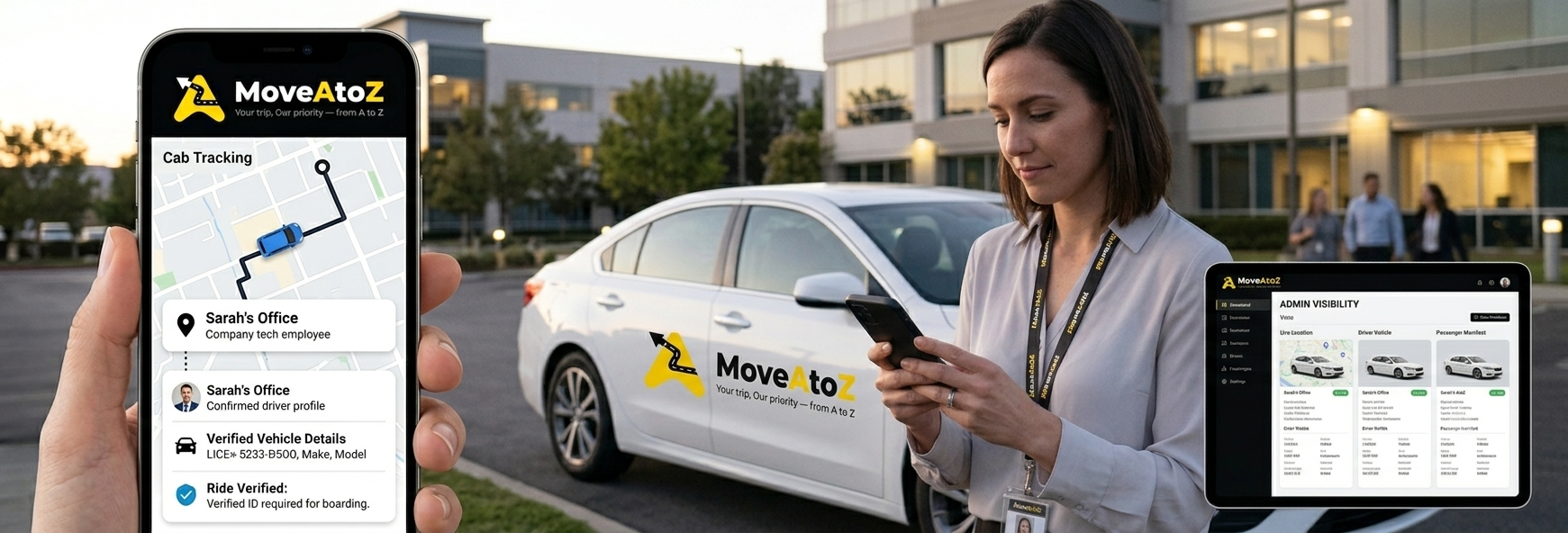
MoveAtoZ approaches this with live fleet tracking visible to both employees and admins, OTP boarding verification, SOS alerts routed to a structured admin workflow, and IVR-based call masking — plus billing that can be run either by vehicle type or by actual seat occupancy, so cost tracking doesn't rely on employees submitting expense claims after the fact.
A few honest questions cut through most of the sales pitch when comparing any Employee Cab Tracking App:
1. Can an admin see every active trip company-wide, not just one employee's individual ride?
2. Is boarding actually verified, or does the system just assume the right person got in?
3. Does cost data come from the app directly, or does it still depend on employees filing expense reports?
4. Is there a real safety escalation path built for the employer relationship, not just a generic in-app SOS button meant for individual riders?
Uber and Ola solve a real problem, just not the one a company actually has once transport becomes something it manages at scale rather than reimburses case by case. An Employee Cab Tracking App isn't a fancier version of the same idea — it's built around a different relationship entirely, one where the company, not just the individual rider, needs to see what's happening, verify it, and account for it. That's the actual reason companies eventually move past "just use Uber" and adopt an Employee Cab Tracking App instead.