For decades, corporate transport planning assumed one simple thing: employees come in every day, at roughly the same time, on roughly the same route. Hybrid work has quietly broken that assumption, and most transport arrangements haven't caught up. This is the gap a Corporate Mobility Platform is built to close — not by replacing the idea of employee transport, but by making it flexible enough to match how people actually work now.
It's tempting to assume hybrid work simply means "less transport needed overall." The reality is messier. Structured hybrid schedules have become the norm rather than the exception — CBRE's 2026 occupancy research found that the large majority of companies with a defined office policy now require at least three in-office days a week, with the "three days in, two remote" pattern emerging as the closest thing to a standard. That doesn't reduce transport demand evenly across the week; it concentrates it.
Attendance data backs this up clearly. CBRE reports that Tuesday is consistently the highest-attendance day across organizations, with Monday and Friday noticeably quieter. Building access data from Kastle Systems, drawn from thousands of buildings across dozens of cities, shows a similar "barbell" pattern — Tuesday through Thursday attendance running roughly double that of Monday and Friday. For anyone coordinating transport, that means demand isn't a flat daily number anymore. It's a spike in the middle of the week and a lull on the edges, and fixed transport contracts built around daily averages tend to handle that badly — either overpaying for capacity that sits idle on quiet days, or scrambling for extra vehicles on the days everyone shows up at once.
Most legacy transport vendor arrangements were built for a five-day, fixed-headcount world. A flat vehicle count, a flat schedule, a flat monthly bill. That model doesn't flex well when attendance genuinely varies by 30-40% between a Tuesday and a Friday, which is roughly what current hybrid attendance data suggests. Companies still running transport this way tend to end up in one of two uncomfortable positions: paying for vehicle capacity that goes unused most of the week, or falling short exactly on the days it matters most.
A Corporate Mobility Platform addresses this directly by treating transport demand as variable rather than fixed — adjusting scheduling and vehicle allocation based on who's actually expected in, rather than a static assumption baked into a yearly vendor contract. This is the core shift a Corporate Mobility Platform makes possible that a manual, spreadsheet-driven process simply can't.
For a hybrid workforce, a Corporate Mobility Platform earns its keep by solving a few specific problems that a rigid, manually-run system usually can't:
A Corporate Mobility Platform that handles these well essentially turns a fixed-cost, fixed-capacity system into something that can breathe with the actual rhythm of a hybrid week.
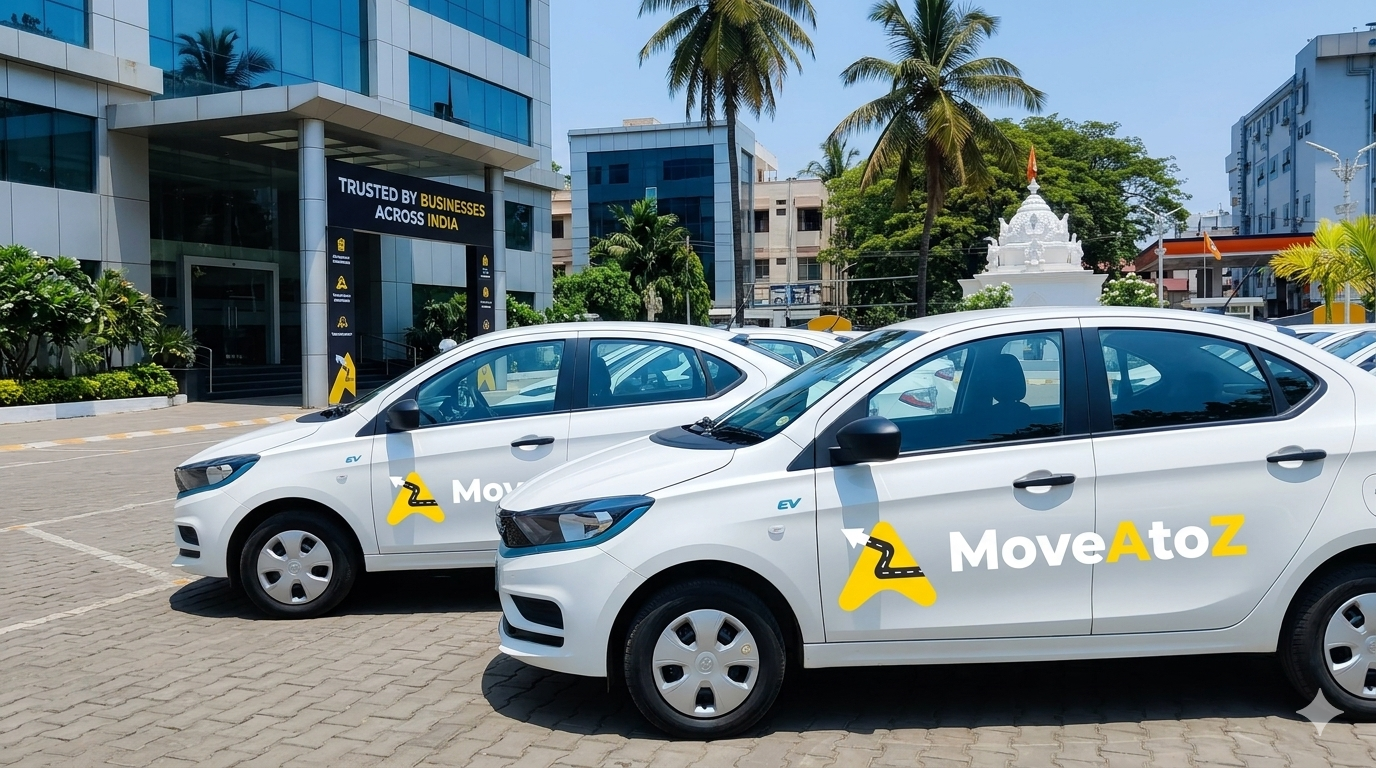
Platforms like MoveAtoZ are built around this kind of flexibility — live vehicle tracking and IVR-based call masking between employees and drivers, designed to handle transport that doesn't follow a fixed daily pattern rather than assuming it does. It's a small but relevant detail for companies whose attendance now genuinely swings from a packed Tuesday to a near-empty Friday.
Commute reliability isn't a purely operational concern anymore — it's tied to how employees experience flexibility itself. Research on hybrid work consistently shows that flexibility has become one of the strongest levers for employee retention, arguably rivaling compensation in how much it influences whether someone stays. If the office days a hybrid employee does come in are marked by unpredictable transport, that undermines the very flexibility the company is trying to offer. A well-run Corporate Mobility Platform isn't just solving a scheduling headache — it's protecting the experience that makes hybrid work worth offering in the first place.
A few practical questions worth asking any provider, specifically through a hybrid-work lens:
1. Does it handle variable daily headcount gracefully, or does it assume a fixed number of riders every day?
2. Can employees book or skip a ride easily, without needing to notify anyone manually in advance?
3. Does it give clear, day-by-day usage data, so costs can be reviewed against actual attendance rather than a flat contract?
4. Does it protect privacy in one-off pairings, given that hybrid schedules mean employees and drivers won't necessarily see each other regularly?
5. Is the mobile experience simple enough for employees who might only use it two or three days a week, rather than daily?
If a Corporate Mobility Platform can answer yes to all five, it's built for how people are actually working now, not how they worked before 2020.
Hybrid work didn't make office transport less important — it made it less predictable, which is a different and, in some ways, harder problem. A Corporate Mobility Platform that's genuinely built for this reality doesn't just move people from A to B. It absorbs the unevenness of a hybrid week — the packed Tuesdays, the quiet Fridays, the employee who's only in twice this week and three times the next — so that flexibility on paper actually translates into a workable commute in practice. That's ultimately what a Corporate Mobility Platform is for.